Ask people who take a lot of notes how often they reread them and the honest answer is usually “almost never”. The notes are there, carefully kept, sometimes well organised, and never opened. Writing them felt productive; reading them never comes up.
This isn’t a character flaw. It’s what happens by default, for reasons that are fairly well understood. This article goes through those reasons and then through fixes that work in practice: resurfacing notes on a schedule, giving them a place, and keeping review small enough that you actually do it.
Why rereading doesn’t happen
Nothing asks you to
Writing has a trigger: something happens and you want to keep it. Rereading has no trigger. No meeting ends with “now go and read what you wrote in March”. Unless something brings an old note in front of you, it stays where it is.
Search doesn’t solve this. Search answers questions you already know to ask. The value of old notes is often in the questions you didn’t know to ask — the connection between a thing you wrote last year and the problem you have today. You can’t search for a connection you haven’t noticed.
The pile is too big to start
After a few years a notes app holds thousands of entries. “Review my notes” in front of a pile that size is like “tidy the house”: there’s no obvious first step and no point at which you’re done, so it never begins.
Old notes are hard to read
Notes written in a hurry, without titles, full of context you no longer have, are unpleasant to reread. Each unpleasant attempt makes the next one less likely. Some of this is fixed at the writing end — see How to take notes you’ll actually come back to — but some of it is fixed by rereading more often, while the context is still fresh.
What we know about forgetting
In the 1880s the German psychologist Hermann Ebbinghaus memorised lists of nonsense syllables and measured how quickly he forgot them. The shape he found — a steep drop soon after learning, flattening out over time — became known as the forgetting curve, and later research has broadly confirmed the pattern for many kinds of material. He also found that relearning was faster than learning from scratch, and that reviews spread out over time were more efficient than reviews crammed together.
That second finding, the spacing effect, is one of the most replicated results in the psychology of memory. It’s the idea behind flashcard systems like Sebastian Leitner’s box of cards and software such as SuperMemo and Anki: you see an item again just as you’re about to forget it, and each successful review pushes the next one further out.
Notes aren’t flashcards, and you don’t need to memorise your notes. But the principle carries over: a note you see again a week, a month and a season after writing it stays alive in your head; a note you never see again doesn’t. The goal of a review habit isn’t to read everything. It’s to make sure old notes come back to you at intervals.
Fix one: let notes resurface
The cheapest way to get spaced rereading is to have something else pick the notes.
- Random or “on this day” notes. Several apps can show a random note, or what you wrote on this date in earlier years. It’s crude but effective: the note chooses you, so you don’t have to decide where to start. In Obsidian the core Random note command does exactly this.
- Highlight resurfacing. Services like Readwise built a business on emailing people a handful of their old book highlights every day. Whatever you think of the product, the mechanism — a small daily dose of old material — clearly works for many people.
- Spaced repetition for notes. Some people put their most important notes into a spaced-repetition schedule (Obsidian has community plugins for this). That’s heavy for everything, but sensible for the few dozen ideas you really want to keep.
The common thread: don’t rely on remembering to remember. Put the resurfacing outside your head.
Fix two: give notes a place
There’s an old memory technique, the method of loci or memory palace. You imagine walking through a building you know well and leave each thing you want to remember at a particular spot; to recall them, you walk the route again. The technique is ancient — Cicero tells the story of the poet Simonides identifying guests at a collapsed banquet hall by remembering where each had sat — and it is still what competitive memorisers use, as Joshua Foer describes in Moonwalking with Einstein.
Why does it work? A rough, honest answer is that people are very good at remembering where things are — routes, rooms, landmarks — and much worse at remembering lists. Neuroscience has a lot to say about spatial memory (the 2014 Nobel Prize in medicine went to John O’Keefe, May-Britt Moser and Edvard Moser for discovering the brain’s “place cells” and “grid cells”), but you don’t need the science to notice it in yourself: you can probably still walk through the house you grew up in.
Most note apps throw this ability away. Notes live in a list sorted by date or title, and the same note shows up in a different position every time the list changes. There’s no where to remember.
You can bring some of it back:
- Stable places. Keep notes in a small number of folders or pages that don’t move around, and resist constant reorganising. A note you always find “second from the top in Projects” is a note with a place.
- Maps and canvases. Laying notes out by hand on a canvas — Obsidian’s Canvas, a whiteboard tool, a sheet of paper — gives them positions you’ll remember.
- Routes. If you review the same areas in the same order each week, the review itself becomes a walk you know.
Fix three: make review small and concrete
The review that happens is the one that’s small enough to start and concrete enough to finish. Some rituals that work:
- The ten-minute Friday. Set a timer. Open whatever the resurfacing tool shows you, or the oldest notes in one area. Stop when the timer stops, even mid-note.
- One job per visit. Each time you open an old note, do one thing to it: sharpen the title, add a link, merge it with a duplicate, or delete it. Leaving every note you touch slightly better makes the collection more pleasant to reread next time.
- Review by area, not by everything. “This week: the reading notes.” A bounded pile has an end.
- Write the next thought. Often the best result of rereading an old note is a new one — what you think now. Link the two.
What doesn’t work, in our experience: grand quarterly reorganisations, elaborate tagging schemes, and anything that requires reading everything. They feel thorough and get abandoned.
A short checklist
- Something outside your head brings old notes back: random notes, a resurfacing email, a schedule.
- Notes have stable places you can picture.
- Reviews are short, timed and have one job per note.
- Each review leaves at least one note better and at least one new link.
Where Aloha fits
We make Aloha, and it was built around the second and third fixes. Skip this if you already have a system you like.
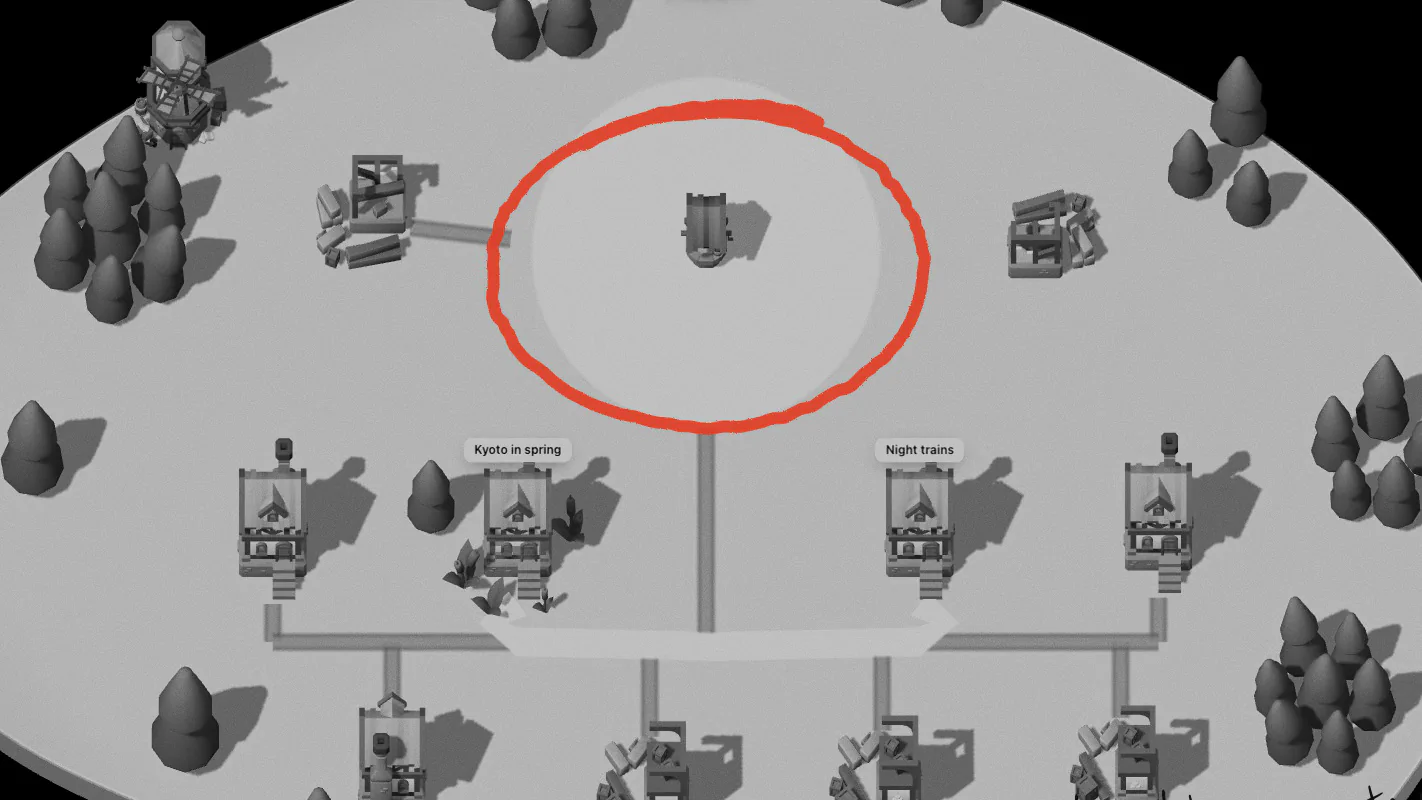
Aloha shows the notes you already have, from an Obsidian vault or Notion, as a small town. Notes are houses and links are roads, and the places stay put: a note is always in the same spot, so you can remember where it lives the way you remember a street.
Old notes don’t hide. A note you haven’t opened for a month fades until you open it, and the list can show only the notes you haven’t opened lately. R walks you to the nearest note you haven’t visited yet, and the walk timer (T) gives you a five-to-sixty-minute session that chimes at the end. How it works has the rest.